



Causal AI Decision Support for Personalized Diuretic Recommendations in Acute Heart Failure with Acute Kidney Injury
PI-Rambam, Asst. Prof. Oren Caspi, MD, PhDPI-Technion, Assoc. Prof. Uri Shalit, currently Tel Aviv University
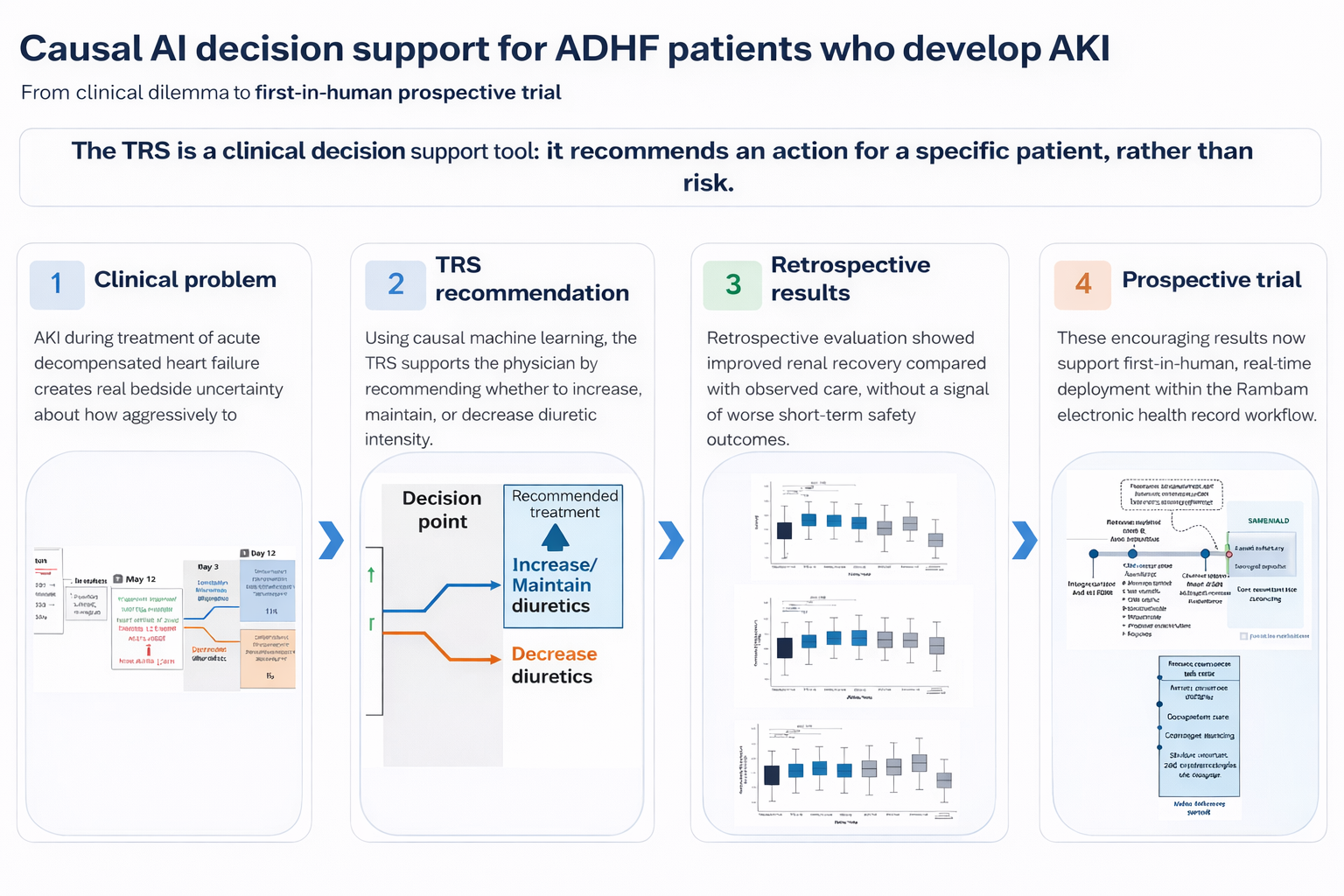
This Technion-Rambam collaboration is developing a causal-AI clinical decision support tool for one of the most difficult dilemmas in acute cardiovascular medicine: how to manage diuretic therapy in heart-failure patients who develop acute kidney injury during hospitalization. Rather than predicting risk, the system provides patient-specific treatment recommendations. Strong retrospective findings have now created the foundation for a first-in-human prospective clinical trial of real-time deployment in routine care.
Clinical problem
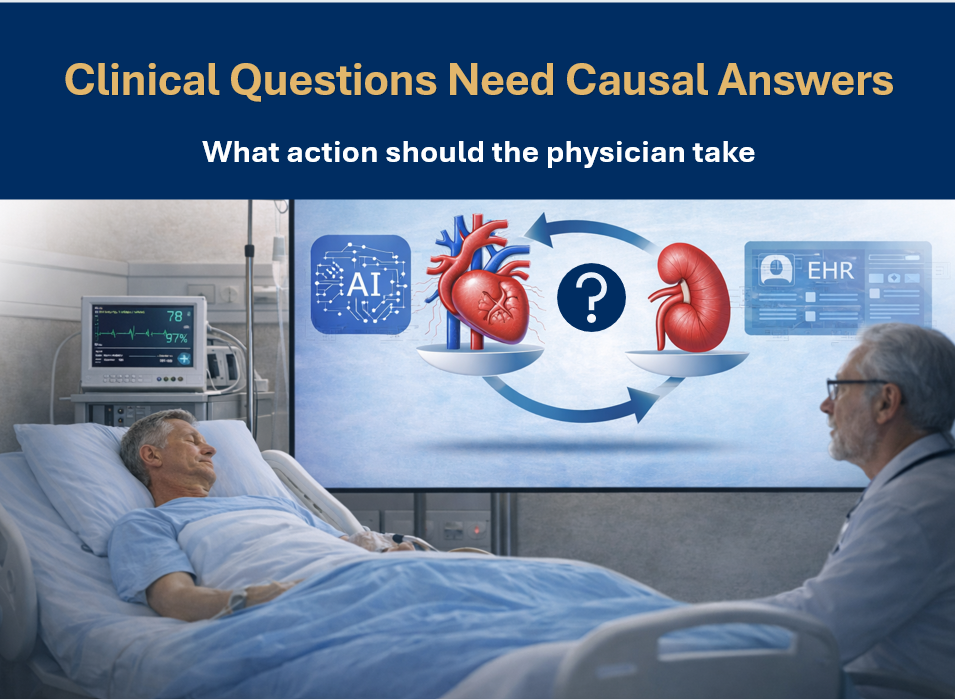
In patients hospitalized with acute decompensated heart failure (ADHF), the development of acute kidney injury (AKI) creates a genuine and high-stakes clinical dilemma.
These patients often need diuretic treatment to relieve congestion and stabilize heart failure, yet the same treatment may worsen renal function. Clinicians must decide whether to increase, maintain, or decrease diuretic intensity at exactly the moment when uncertainty is highest. Because patient responses vary substantially, this decision is difficult to standardize and remains one of the most challenging situations in acute cardiorenal care.
AI approach
This project addresses that dilemma through a clinical decision support tool, the Targeted Recommendation System (TRS). Importantly, the TRS is not a prediction model. Instead, it is a causal machine-learning system designed to support action: it evaluates patient-specific clinical data and recommends the most appropriate treatment strategy at the bedside. At the key clinical decision point, the system can recommend whether diuretic intensity should be increased, maintained, or decreased, and it can also defer when confidence is limited. By focusing on treatment effect rather than simple risk prediction, the TRS is designed to help physicians choose what to do, not merely predict what might happen.
Research goals
The goal of this Technion-Rambam collaboration is to develop and validate a new class of AI-enabled clinical decision support for high-uncertainty medical care. In the current project, the aim is to improve personalized diuretic management in ADHF patients who develop AKI, integrate the TRS directly into Rambam’s electronic health record, and translate strong retrospective evidence into a first-in-human prospective clinical trial. The broader vision is to establish a scalable framework for causal AI recommendation systems that can be deployed across hospitals and, eventually, across international healthcare environments.
Research achievements to date
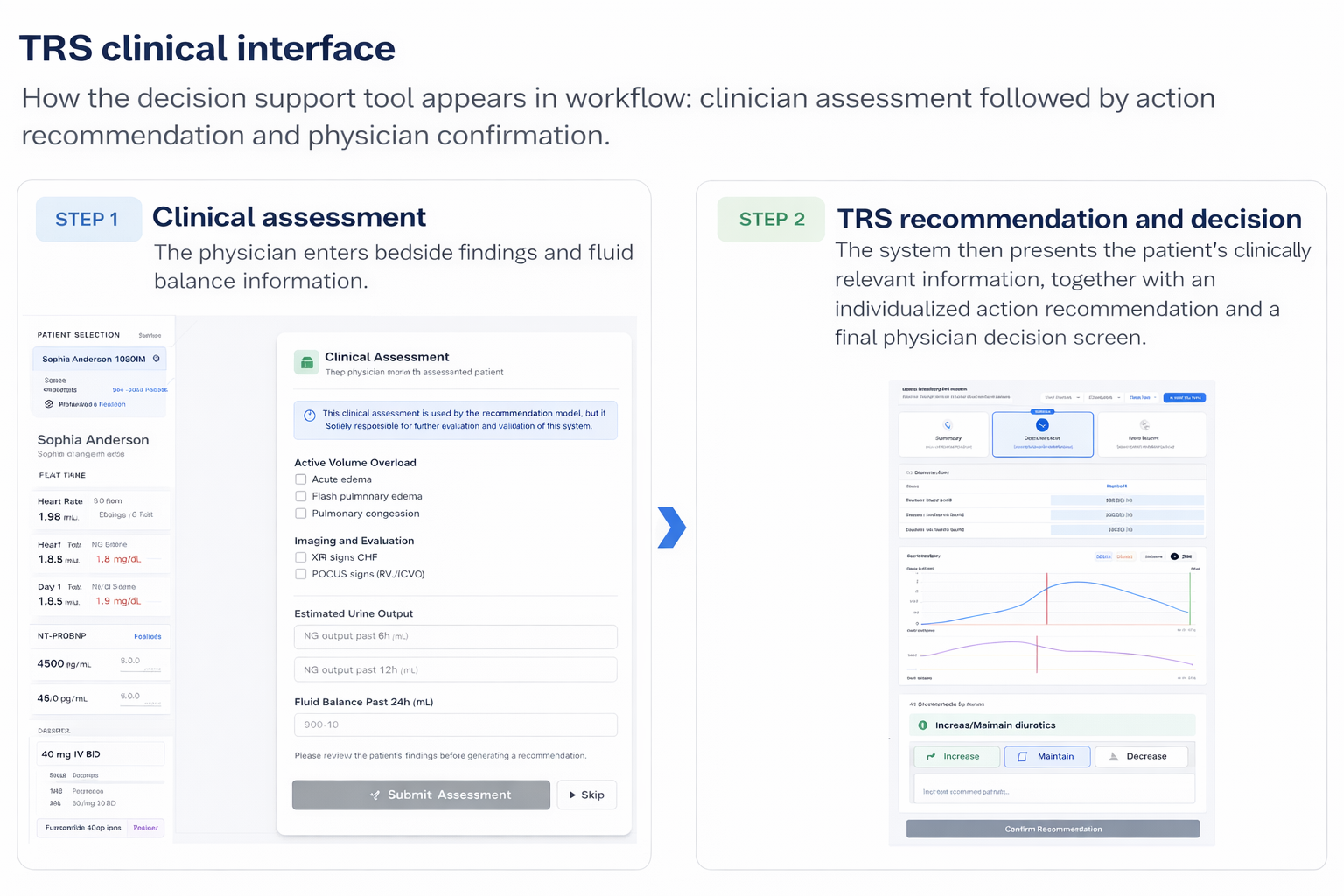
The collaboration has already produced strong retrospective results supporting prospective clinical testing. In retrospective analysis from Rambam, the TRS improved renal recovery outcomes compared with observed standard care, without adversely affecting in-hospital mortality or 30-day rehospitalization/death in the model-based evaluation. The system was developed using rich real-world EHR data and more than 200 structured clinical variables. Beyond the retrospective work, the team has also prepared the infrastructure needed for clinical translation, including physician review of TRS recommendations, development of a user interface designed for clarity and adoption, and planning for integration into Rambam’s EHR. In parallel, the team developed a physician-facing user interface in collaboration with clinicians. The interface presents the patient’s clinically relevant information together with the TRS recommendation in a clear, intuitive format designed for real-time use in the hospital workflow. These achievements are now serving as the basis for a first-in-human, prospective, stepped-wedge randomized clinical trial of a causal decision support system in real-time practice.
 |
 |
Publications
- Gutman, R., Aronson, D., Caspi, O., & Shalit, U. (2022). What drives performance in machine learning models for predicting heart failure outcome? European Heart Journal – Digital Health, 4(3), 175–187. https://doi.org/10.1093/ehjdh/ztac054(opens in new tab)
- Gutman, R., Sheiba, S., Klein, O. N., Bird, N. D., Gruber, A., Aronson, D., Caspi, O., & Shalit, U. (2025). From observational data to clinical recommendations: A causal framework for estimating patient-level treatment effects and learning policies. arXiv. https://doi.org/10.48550/arXiv.2507.11381(opens in new tab)
Conference Presentations
- Gutman, R., Gruber, A., Dekel Bird, N., Aronson, D., Caspi, O., & Shalit, U. (2024). Causal ML-based policy for managing diuretics for AKI in AHF patients. Presented at ICI 2024, Tel Aviv, Israel.
- Gutman, R., Sheiba, S., Aronson, D., Shalit, U., & Caspi, O. (2024). Using causal machine learning for treatment recommendation in acute settings. Presented at INFORMS, Indianapolis, IN, USA.
- Caspi, O., Gutman, R., Aronson, D., & Shalit, U. (2023). Individualized recommendations for treating patients with acute kidney injury in the setting of acute heart failure by a novel strategy using causal machine learning. European Journal of Heart Failure Conference, Vienna, Austria.